Marble vs Granite vs Homogeneous Tiles: Which Flooring Is Best for Singapore Homes?
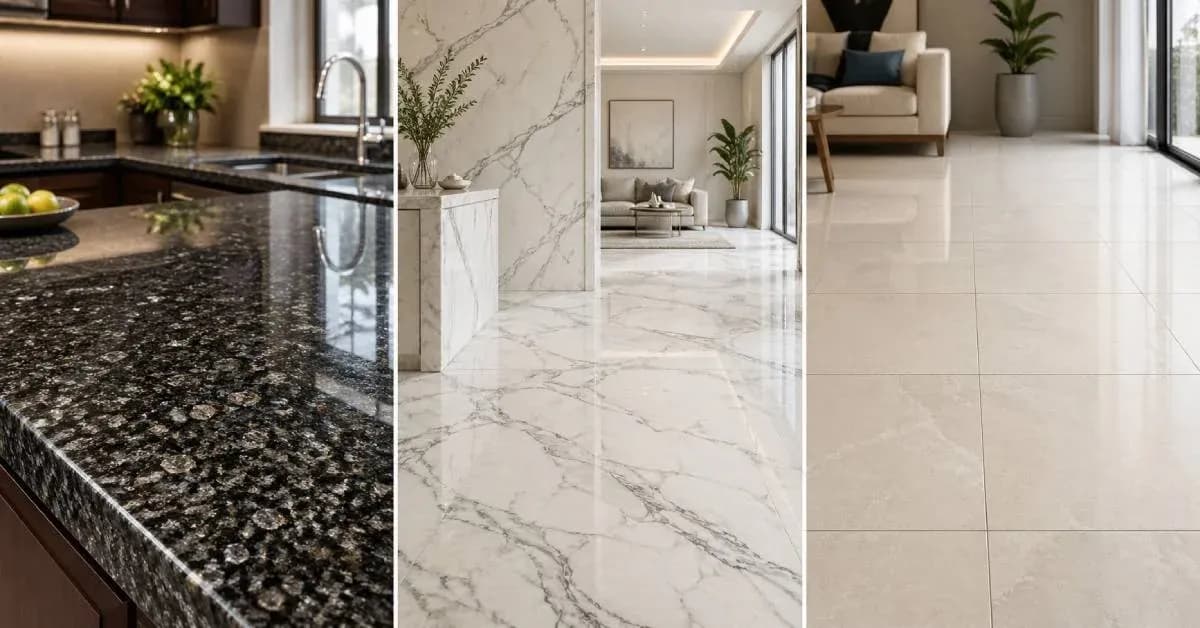
Choosing Flooring in Singapore: Marble, Granite or Homogeneous Tiles?
Walk into any Singapore flooring showroom and you will be presented with three dominant options for living areas: marble, granite and homogeneous tiles. Each has loyal fans, each has real drawbacks, and the right answer depends far more on how you live than on which one looks best in a showroom.
This guide compares the three materials on the things that actually matter in Singapore: cost, humidity resistance, maintenance, comfort and long-term appearance.
Quick Comparison at a Glance
Factor | Marble | Granite | Homogeneous Tiles |
|---|---|---|---|
Look | Soft, luxurious veining | Speckled, heavy, natural | Uniform, wide variety of finishes |
Hardness | Softer, scratches and etches | Very hard, scratch resistant | Hard and dense |
Stain resistance | Low without sealing | Moderate | High |
Cool underfoot | Yes | Yes | Yes |
Maintenance | Regular polishing and sealing | Periodic polishing | Simple mopping |
Indicative cost | Highest | High | Lowest |
Repairability | Can be polished and refinished | Can be polished and refinished | Replace individual tiles |
Marble Flooring
Marble remains the premium choice for Singapore living and dining areas. Its soft veining reflects light beautifully, and it stays cool underfoot in the tropical heat.
Pros:
Unmatched elegance and resale appeal in condominiums and landed homes.
Can be ground, honed and polished repeatedly to restore a mirror finish.
Cool surface that suits Singapore's climate.
Cons:
Soft surface that scratches, chips and etches from acids.
Requires sealing and regular professional polishing.
Higher upfront and long-term maintenance cost.
Marble suits homeowners who are willing to maintain it and who value appearance above convenience.
Granite Flooring
Granite is the practical cousin of marble. It shares the cool-to-touch quality but is significantly harder and more resistant to scratching.
Pros:
Excellent durability for high-traffic areas.
Resists heat, scratches and most spills.
Can be polished to restore gloss, though less dramatically than marble.
Cons:
Darker, heavier appearance that can make small rooms feel closed in.
Limited colour range compared with marble or tiles.
Can be slippery when polished and wet.
Granite is a strong option for kitchens, service yards, balconies and high-traffic corridors.
Homogeneous Tiles
Homogeneous porcelain tiles are the most common flooring in newer Singapore apartments, and for good reason. They are dense, non-porous and available in finishes that convincingly imitate marble, concrete and wood.
Pros:
Highly stain and water resistant with minimal maintenance.
Huge range of sizes, textures and finishes.
Cost-effective and easy to replace individual damaged tiles.
Can be professionally polished to restore a satin or gloss finish.
Cons:
Grout lines need regular attention and can discolour.
Can feel clinical or repetitive in large open areas.
Hard surface that is unforgiving if something heavy is dropped.
Homogeneous tiles are the sensible choice for families, rental properties and anyone who prioritises low maintenance.
Which Material Suits Which Room?
Living and dining rooms: Marble for a premium look, homogeneous tiles for practicality.
Kitchen: Granite or homogeneous tiles, both handle spills better than marble.
Bathrooms: Homogeneous tiles with epoxy grouting, not polished marble.
Balcony and service yard: Granite or textured homogeneous tiles for slip resistance.
Bedrooms: Parquet or engineered wood for warmth and comfort.
Cost Over Ten Years
Material | Upfront Cost | Ongoing Maintenance | Long-Term Note |
|---|---|---|---|
Marble | High | Polishing every 1 to 2 years | Refinishable, retains value |
Granite | High | Polishing every 2 to 3 years | Very durable |
Homogeneous tiles | Low to moderate | Cleaning plus occasional polishing | Cheapest to own |
Can Homogeneous Tiles Be Polished Like Marble?
Yes. Dull or scratched homogeneous tiles can be mechanically polished to restore their original sheen, which is far cheaper than hacking and retiling. Deep scratches and surface etching can be removed with diamond abrasives, and grout lines can be refreshed at the same time.
Frequently Asked Questions
Is marble suitable for Singapore's humidity?
Yes, provided it is sealed and cleaned with pH-neutral products. The main risk is moisture trapped in unsealed stone, which can cause staining and dullness rather than structural damage.
Are homogeneous tiles cheaper than marble?
Generally yes, both in material and installation cost. Homogeneous tiles are usually the most economical option of the three.
Which flooring adds the most resale value?
Well-maintained marble tends to impress buyers most, but badly worn or stained marble can hurt a sale. Condition matters more than material.
Can I polish granite and marble the same way?
The tools are similar, but the abrasives, compounds and pressure differ because granite is much harder. A contractor should be able to explain the difference for your specific stone.
Not Sure Which Floor You Have?
Asrafi Renovation Pte Ltd provides free on-site assessments across Singapore and can identify your stone or tile type before recommending polishing, sealing or replacement.
Call or WhatsApp +65 8464 2371 or visit 101 KITCHENER ROAD, #03-04A, JALAN BESAR PLAZA, SINGAPORE 208511. Open daily, 9am to 10pm.
Found this helpful? Share it.